
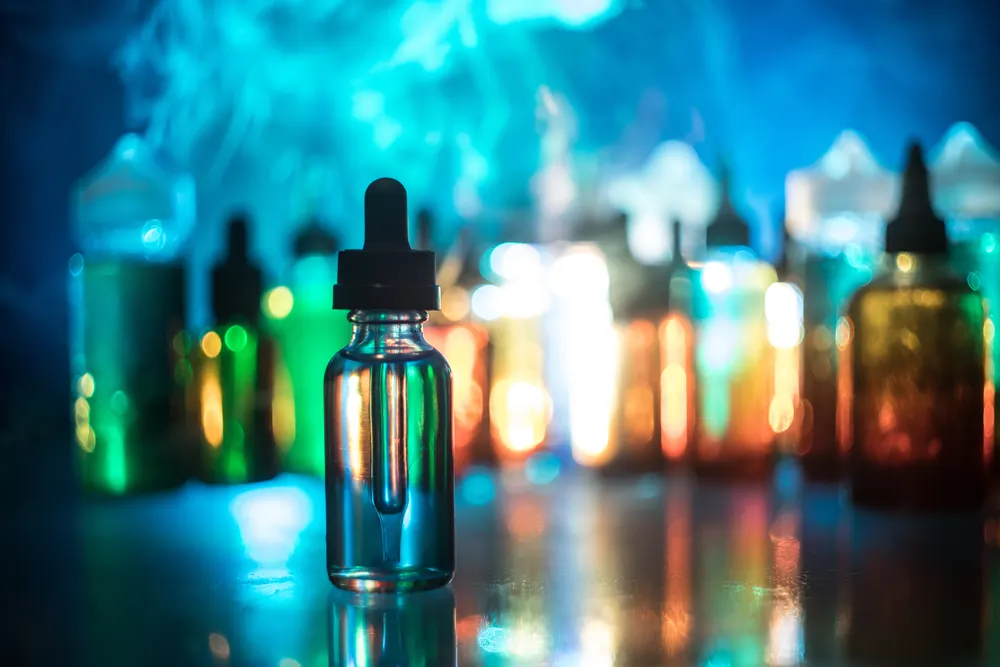
E-liquids are at the heart of how vapes work. Available in different compositions and nicotine strengths, they play an essential role in producing vapour and in how devices operate.
At Vape Wôlinak, we believe it is important to properly understand the characteristics of e-liquids in order to know their differences, their composition and the precautions to take.
What is an e-liquid?
An e-liquid is a solution specially designed to be heated by the coil of a vape. When heated, it produces an aerosol that is inhaled by the user.
Most e-liquids are made of several ingredients:
- Propylene glycol (PG): A liquid that helps carry flavours and produces the sensation felt in the throat.
- Vegetable glycerin (VG): A thicker liquid that helps produce a denser aerosol.
- Flavourings: Ingredients that give the liquid a particular flavour, where their use is permitted.
- Nicotine: A substance that may be present in different strengths and that is addictive.
The exact composition may vary depending on the manufacturer and the product.
Understanding the differences between PG and VG
The PG/VG ratio represents the proportion of propylene glycol and vegetable glycerin contained in an e-liquid.
A high-PG liquid:
- Generally has a thinner texture.
- Produces a stronger throat sensation.
- Usually generates a less dense aerosol.
A high-VG liquid:
- Has a thicker texture.
- Generally produces a denser aerosol.
- May require a suitable device and coil.
For example, a 50/50 ratio means that the liquid contains equal proportions of PG and VG.
It is important to check that the liquid is compatible with the device used.
The different types of nicotine
There are two main forms of nicotine used in e-liquids.
Traditional nicotine (Freebase)
Freebase nicotine is a form of nicotine commonly used in vape liquids.
It can produce a stronger throat sensation, especially as its strength increases.
Nicotine salts (Nic Salt)
Nicotine salts are obtained through a different formulation that changes, among other things, the pH of the liquid.
They can offer a less irritating throat sensation at an equivalent strength, without reducing the risks associated with nicotine.
Remember: Both forms contain nicotine, a substance that is addictive.
Understanding nicotine strengths
Nicotine strength is generally shown in milligrams per millilitre (mg/ml).
Here are a few examples:
- 0 mg/ml: No added nicotine.
- 3 mg/ml: Contains 3 milligrams of nicotine per millilitre.
- 6 mg/ml: Contains 6 milligrams of nicotine per millilitre.
- 12 mg/ml: Contains 12 milligrams of nicotine per millilitre.
- 20 mg/ml: Contains 20 milligrams of nicotine per millilitre.
In Canada, the maximum nicotine concentration allowed in vaping products containing nicotine is 20 mg/ml.
The amount of nicotine actually absorbed depends on the device, its power and the way it is used.
Why are some e-liquids thicker than others?
The viscosity of an e-liquid depends mainly on its PG/VG ratio.
A thicker liquid may flow more slowly through some coils, while a thinner liquid may be less suitable for some tanks.
Using an incompatible liquid can cause various problems:
- Leaks.
- Poor liquid supply to the coil.
- A burnt taste.
- Premature wear of the coil.
It is therefore important to follow the recommendations of the vape’s manufacturer.
How should you store your e-liquids?
Proper storage helps preserve the characteristics of the product and limit the risk of accidents.
Here are a few important precautions:
- Store the bottles in a cool, dry place.
- Avoid direct exposure to sunlight and heat.
- Always close the containers properly.
- Keep the products in their original packaging.
- Keep e-liquids out of the reach of children and pets.
Caution: E-liquids containing nicotine can cause poisoning if swallowed or improperly handled. In case of accidental exposure, contact a poison control centre immediately.
Do e-liquids have an expiry date?
E-liquids generally have a shelf life recommended by their manufacturer.
Over time, some changes may appear:
- A change in colour.
- A change in smell.
- Altered flavours.
- Gradual degradation of certain ingredients.
A change in colour does not automatically mean that a liquid is unusable. However, it is best to follow the manufacturer’s instructions and not to use a product whose integrity seems compromised.
Are e-liquids safe?
No. Even when an e-liquid contains no nicotine, using it is not without risk.
Heating liquids can lead to the formation of potentially harmful substances. The health effects depend on the composition of the product, the device and usage habits.
Vaping is not recommended for non-smokers, young people or pregnant people.
Vape Wôlinak: better understanding vaping products
At Vape Wôlinak, we place great importance on information and on understanding products.
Whether it is the composition of an e-liquid, its nicotine strength, its PG/VG ratio or its compatibility with a device, our team can help you understand the technical characteristics of products.
An informed consumer is a consumer who better understands the products they use and the precautions that come with them.
